The Divergence Theorem
The divergence theorem provides a link between a flux integral over a closed surface  and a volume integral over the volume
  bounded by
  It states that the flux of a vector field F through a closed surface
 is a measure of the divergence of F in
  , the interior of
Divergence Theorem
Let  be a closed and bounded region in
  whose boundary
  consists of a piecewise smooth surface that is oriented outward. Let n be the outward normal to
  and F
and F a vector field whose components are continuous and have continuous first-order partial derivatives at all points of
  and
and  Then
Then


Divergence Integral
The requirement that  consist of a piecewise smooth surface is to ensure that
  is a simple surface, one that does not intersect itself. This means that there cannot be more than one normal vector n at any point.
Use of the divergence theorem is of practial interest because one of the two kinds of integral is often simpler than the other.

The divergence theorem is extremely useful in the derivation of some of the famous equations in electricity, magnetism and hydrodynamics. One example is the equation of continuity for fluid flows.
Let  be the closed region consisting of a sphere
  and its interior. We know that the total mass of a fluid in
  is given by
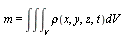
and the rate at which the mass increases in  is given by


The mass of the fluid flowing through an element of surface area  per unit time is

If we assume that the change in mass in  is due only to the flow in and out of
  then the rate at which the mass increases in
  is
is


And according to the divergence theorem


Then we have


or
 (
(
 )
)
Since this result is to hold for every sphere, we obtain.

 = 0
= 0
which is the equation of continuity for fluid flows.
Example 1
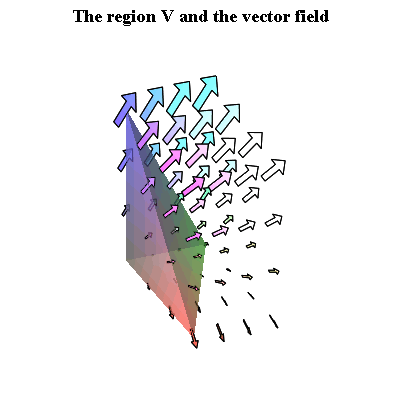
Verify the divergence theorem for F = ![[`+`(x, `-`(y)), `+`(y, `*`(2, `*`(z))), `+`(`*`(3, `*`(z)), `-`(x))]](images/Some Pages_905.gif) if
if  is the surface of the tetrahedron bounded by the three coordinate planes and the plane
  .
.
Solution
| > | restart: MathMaple:-ini(): |
a)
|
|
||||||||||||||||
|
|
||||||||||||||||
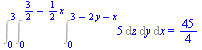
The Triple Integral
|
We let the four planes be
|
||||||||||||||||
If
|
we have
|
||||||||||||||||
q = k
|
We substitute
|
||||||||||||||||
then
|
|
||||||||||||||||
|
For
y = 0 gives
|
||||||||||||||||
|
For
|
||||||||||||||||
For
|
|
||||||||||||||||
The Surface Integral
|
|||||||||||||||||
![[`+`(x, `-`(y)), `+`(y, `*`(2, `*`(z))), `+`(`*`(3, `*`(z)), `-`(x))]](images/Some Pages_909.gif)

![S[1]](images/Some Pages_912.gif) :
: ![`+`(x, `*`(2, `*`(y)), z) = 3, S[2]](images/Some Pages_913.gif) :
: ![y = 0, S[3]](images/Some Pages_914.gif) :
:  and
and ![S[4]](images/Some Pages_916.gif) :
:  The surface integral is defined by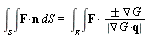

![S[1]](images/Some Pages_920.gif) is a level surface of
is a level surface of 
![[1, 2, 1]](images/Some Pages_922.gif)





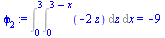
![S[2]](images/Some Pages_928.gif) :
:  , n = j

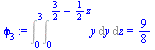
![S[3]](images/Some Pages_933.gif) :
:  , n = i
 gives
gives 
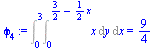
![S[4]](images/Some Pages_939.gif) :
:  , n =
, n =  k
k 
 gives
gives 


We see that rather than evaluate four surface integrals, the divergence theorem let us evaluate one triple integral.